
Introduction
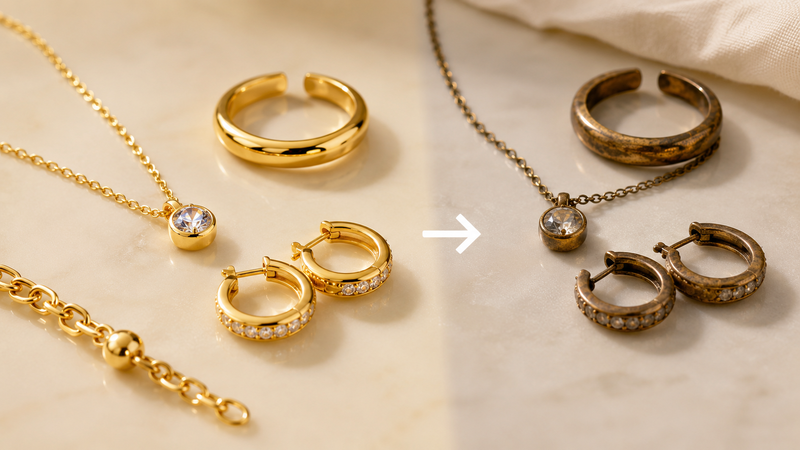
Yes, gold plated jewelry can tarnish, fade, or show the base metal as its surface finish changes over time. Gold plated jewelry is made by covering brass, 925 sterling silver, stainless steel, or another metal with a thin layer of gold rather than using solid gold throughout. Sweat, moisture, friction, perfume, sunscreen, cleaners, and unsuitable storage can all accelerate visible surface changes. Actual performance also depends on the base metal, plating thickness, surface preparation, underlayer, protective coating, and product structure. This guide helps consumers understand discoloration while giving jewelry brands practical checks for approving samples, controlling bulk production, and reducing avoidable complaints.
Quick Answer
Yes, gold plated jewelry can change color, but fading, residue, plating wear, and tarnish are not always the same problem. The surface may change when the gold layer becomes worn, porous, contaminated, or exposed to sweat, moisture, friction, cosmetics, and chemicals. There is no universal lifespan because both manufacturing quality and customer care affect performance.
Does Gold Plated Jewelry Tarnish?
Gold plated jewelry may become dull, dark, pale, patchy, or reveal a different base color. The gold layer is relatively stable, but daily wear can thin it and expose brass, copper, or sterling silver to air, sweat, moisture, and chemicals.
High-friction areas usually change first, including ring bottoms, bracelet interiors, clasps, chain links, and pendant loops. Light residue may clean away, while real plating loss normally requires professional replating.
Tarnish, Fading, and Plating Wear Are Different
Tarnish is a surface reaction that can darken exposed metal, while fading means the gold tone becomes lighter without necessarily oxidizing. Plating wear is physical loss of the gold layer, and residue is a removable deposit from sweat, lotion, soap, perfume, or cleaner.
For complaint analysis, record the location, wearing time, product type, friction level, water or chemical exposure, cleaning result, and any visible base-metal color. This separates customer-care issues from genuine finish failure.
Why Gold Plated Jewelry Changes Color
Thin or Undefined Plating
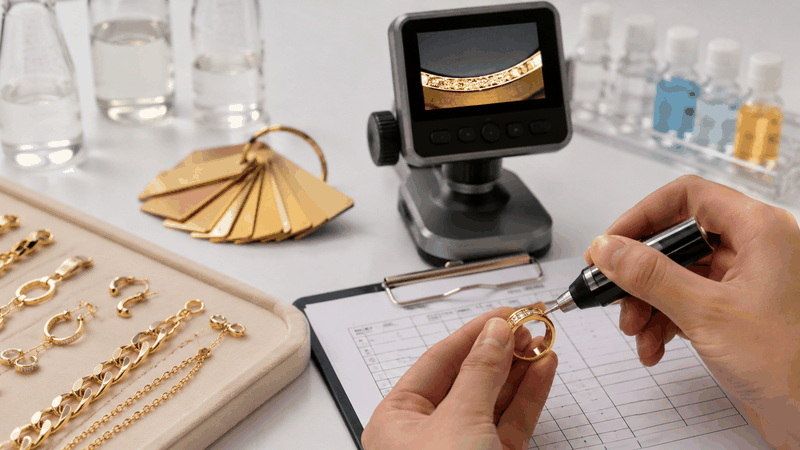
“Gold plated” is not a complete product specification. Buyers should confirm the gold karat, gold color, target thickness, thickness tolerance, measurement point, underlayer, and protective coating before approving a quotation.
Terms such as “thick plating” or “premium plating” are difficult to inspect. A measurable specification gives the buyer and supplier the same standard for samples, bulk orders, testing, and repeat production.
Poor Surface Preparation
Plating cannot fully hide poor surface preparation. Scratches, polishing wax, grease, fingerprints, welding residue, pores, rough edges, and incomplete cleaning may remain visible or create weak areas under the finish.
Surface preparation should cover polishing, cleaning, activation, and inspection. Grooves, solder joints, stone settings, recessed areas, and moving parts deserve particular attention because coverage may be more difficult to control.
Reactive Base Metals
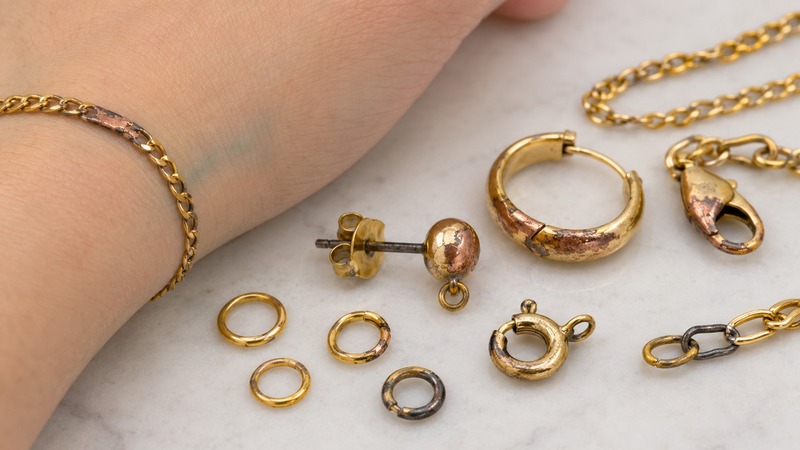
Base metals behave differently when the gold layer becomes thin or worn. Brass and copper may reveal a warm copper color, develop dark oxidation, or contribute to green skin marks, while exposed sterling silver may become gray or black.
Buyers should confirm more than the main body material. Ear posts, clasps, springs, solder, jump rings, and chain components may use different metals and change at different rates.
Friction and Daily Wear
Friction is one of the main causes of plating loss. Ring bottoms, bracelet interiors, Cuban-link contact points, clasps, earring posts, pendant holes, and movable joints usually experience more abrasion than decorative front surfaces.
A low-friction pendant and a daily-wear ring should not automatically follow the same durability assumptions. Plating, testing, and inspection requirements should match the actual product structure.
Water and Chemicals
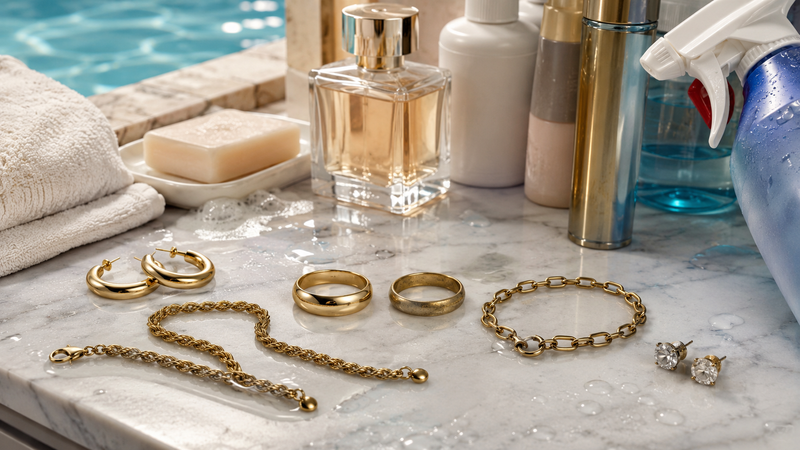
Sweat, seawater, chlorine, perfume, sunscreen, lotion, hairspray, soap, and household cleaners can leave deposits or accelerate surface wear. Repeated contact may also affect a clear protective coating.
Brands should avoid describing every plated product as completely waterproof. A reliable product description explains care requirements and tested conditions instead of promising permanent color.
Packaging and Storage
Plated jewelry can develop surface problems before reaching the customer. High humidity, incomplete drying, adhesive fumes, unsuitable foam, rubber contact, dirty inserts, and prolonged open storage may affect the finish.
Final inspection should include dryness, cleanliness, color consistency, visible marks, and packaging compatibility. Suitable storage and moisture control can reduce unnecessary exposure before sale.
How Long Does Gold Plated Jewelry Last?
| Surface Condition | Typical Appearance | Possible Cause | Common Response |
|---|---|---|---|
| Surface residue | Dull, greasy, or cloudy | Sweat, lotion, or soap | Gentle cleaning |
| Tarnish | Darkening or color change | Reaction in exposed metal | Clean or refinish |
| Fading | Gold tone becomes lighter | Gradual plating wear | Replate |
| Exposed base metal | Silver or copper color appears | Local plating loss | Replate |
| Green marks | Green discoloration on skin | Copper-based metal reacting with sweat | Clean and inspect plating |
Gold plated jewelry does not have one universal lifespan. Actual performance depends on the base metal, plating thickness, underlayer, coating, product design, wearing frequency, skin chemistry, storage, cleaning, and chemical exposure.
A controlled plating system may improve durability, but salt spray, abrasion, or artificial sweat tests should not be converted directly into a promise of lifetime wear.
How Base Metals Affect Plating Performance
The base metal influences cost, structure, appearance, and the way plating wear becomes visible. Buyers should select it according to product positioning, design complexity, destination market, and expected use.
| Base Metal | Advantages | Main Risks | Common Products |
|---|---|---|---|
| Brass | Formable and cost-controlled | Copper tone or green marks may appear after wear | Pendants, earrings, fashion rings |
| 925 sterling silver | Precious-metal positioning and fine detail | Exposed silver may tarnish | Rings, necklaces, gift jewelry |
| Stainless steel | Good strength and corrosion resistance | Requires stable preparation and adhesion control | Chains, bracelets, daily-wear styles |
| Copper | Easy to process and plate | Oxidizes readily and shows an obvious base color | Fashion jewelry |
| Zinc alloy | Suitable for complex shapes | Material stability and adhesion require control | Large statement pieces |
A complete specification should state base metal + gold karat + gold color + plating thickness + underlayer + protective coating, rather than using only the phrase “gold plated jewelry.”
Gold Plated, Vermeil, and Gold Filled Compared
Gold tone, gold plated, gold vermeil, gold filled, and solid gold are not interchangeable terms. They describe different constructions, price positions, wear characteristics, and labeling requirements.
Brands selling in the United States should review the official FTC Jewelry Guides. Material descriptions must match the product’s actual construction and the requirements of the destination market.
Which Jewelry Types Lose Plating Fastest?
Wear risk changes according to the product type and contact area. The same plating specification may not deliver the same result across every SKU in a collection.
| Product Type | Wear Risk | High-Risk Locations | Buyer Inspection Focus |
|---|---|---|---|
| Rings | High | Band bottom and sides | Thickness, friction, and edge coverage |
| Bracelets | High | Interior, clasp, and jump rings | Sweat, movement, and contact areas |
| Cuban chains | High | Link surfaces and clasp | Coverage, solder joints, and movement |
| Necklaces | Medium | Back neck, clasp, and pendant connection | Sweat, perfume, and component consistency |
| Earrings | Low¨Cmedium | Posts, backs, and welds | Post material, smoothness, and solder quality |
| Pendants | Low | Bail, edges, and back surface | Edge coverage and local scratches |
High-friction rings and low-friction pendants should have separate risk assumptions. Buyers should inspect real contact areas rather than checking only the most visible front surface.
How to Prevent Tarnish and Plating Wear
Customers should wipe plated jewelry with a soft, lint-free cloth, dry it fully after moisture exposure, and remove it before showering, swimming, exercising, or using strong cleaners. Perfume, sunscreen, lotion, and hairspray should dry before jewelry is worn.
Store individual pieces separately and avoid toothpaste, aggressive cleaners, rough polishing cloths, and humid bathrooms. Repeated rubbing between chains, rings, or bracelets can gradually damage the plated finish.
Brands should provide finish-specific care cards for plated silver, rings, pearls, enamel, glued designs, and textured products. A cleaning method suitable for unplated silver may damage a gold plated silver surface.
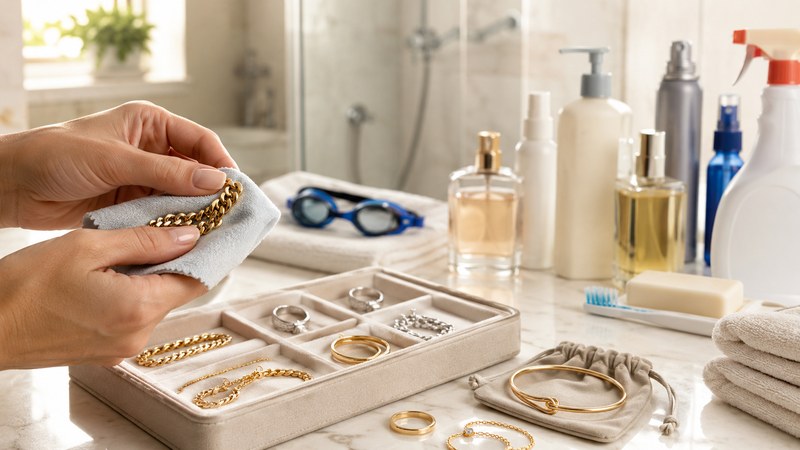
Product pages should identify the base metal and finish without claiming “never tarnishes” or “permanent color.” Clear expectations reduce preventable complaints and support more consistent after-sales decisions.
What Buyers Should Check Before Bulk Orders
Confirm Every Base Material
Confirm the main body, ear posts, clasps, springs, jump rings, solder, chains, and findings. Mixed components may age at different rates even when the finished product initially looks consistent.
Approve the Gold Color
Approve the karat tone, yellow, rose, or white color, physical reference sample, and acceptable variation. The same approved color standard should be used for bulk production and future reorders.
Specify Plating Thickness
Record the target micron, tolerance, measurement location, high-friction areas, test method, and required report. Do not accept vague descriptions such as “extra thick plating” without measurable criteria.
Review the Underlayer
The underlayer may influence adhesion, smoothness, color consistency, and metal migration. Buyers selling into Europe should review the European Chemicals Agency’s official REACH information when defining materials, coatings, and restricted-substance controls.
Inspect Surface Preparation
Inspect the front, back, edges, grooves, welds, settings, clasp interiors, and moving connections. Surface-preparation problems frequently appear first in recessed or technically difficult areas.
Confirm the Protective Coating
If e-coating or another clear layer is used, define its coverage, curing, gloss, surface feel, adhesion, and repair limits. A protective coating may reduce direct exposure, but it cannot make plating permanent.
Approve a Physical Sample
Keep an approved sample with photos, CAD or dimensions, weight, plating specification, color reference, stone details, testing records, packaging, and defect limits. This sample becomes the production benchmark instead of relying on memory or chat messages.
Control Bulk Consistency
Inspect first articles, in-process units, batch color, coverage, welds, clasps, stone security, packaging cleanliness, and final shipment quality. The principles of ISO 9001 quality management support process control and recordkeeping, but certification alone does not prove that plating will never wear.
How Suppliers Test Gold Plated Jewelry
Testing helps compare processes and production batches, but no single test predicts every customer’s wear experience. Test conditions, sample preparation, measurement locations, and acceptance limits should always be recorded.
| Test | What It Checks | Important Limit |
|---|---|---|
| Thickness test | Plating thickness | Measurement location must remain consistent |
| Adhesion test | Bonding of the surface layer | Does not represent total service life |
| Abrasion test | Resistance to rubbing | Should target actual wear areas |
| Artificial sweat test | Response to simulated sweat | Conditions must be documented |
| Salt spray test | Comparison of surface systems | Cannot be converted into wearing years |
| Color comparison | Sample and batch consistency | Requires an approved color standard |
| Visual inspection | Pores, variation, and exposed metal | Requires consistent lighting and criteria |
| Component test | Clasps, welds, and moving parts | Should cover more than the front surface |
Testing supports better comparisons, not absolute guarantees. Results are most useful when the same method is applied to the approved sample, production batches, and future process changes.
Common Gold Plating Claims Brands Should Avoid
Avoid unconditional claims such as “never tarnishes,” “tarnish-proof,” “completely waterproof,” “sweat-proof,” “lifetime plating,” “permanent gold color,” “hypoallergenic for everyone,” or “safe for every skin type.”
More reliable wording includes “designed for regular wear with appropriate care,” “protective coating applied,” and “tested under defined conditions.” Brands can also advise customers to remove jewelry before swimming or using strong chemicals.
Questions to Ask a Gold Plated Jewelry Supplier
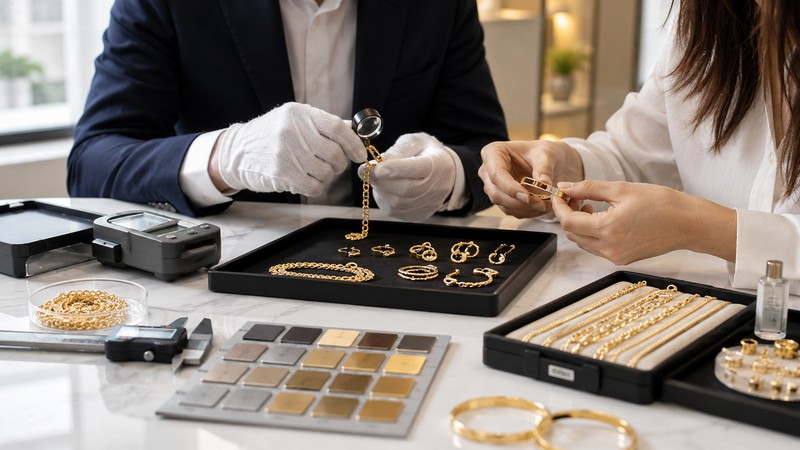
Use these questions before comparing quotations:
- What is the exact base metal and component material?
- What gold karat, color standard, and target thickness will be used?
- Where will the plating thickness be measured?
- What thickness tolerance will be accepted?
- Is an underlayer or protective coating included?
- Which adhesion, abrasion, sweat, or color tests are available?
- How will the approved physical sample be recorded?
- How is batch-to-batch color consistency controlled?
- Which high-risk areas receive final inspection?
- Can the supplier support a low-MOQ trial order?
- How will repeat-order specifications be retained?
These questions help buyers compare the same production standard, rather than choosing a supplier based only on the lowest unit price.
How Missjeweler Supports Gold Plated Jewelry Projects
Missjeweler treats gold plating as a controlled development process, not a permanent-color promise. Buyers define materials, color, thickness, coating, testing, packaging, and inspection points before scaling.
| Buyer Risk | Missjeweler Support |
|---|---|
| Unclear specifications | Clarify base metal, gold color, and finish |
| Sample and bulk inconsistency | Retain approved samples and key records |
| First-order inventory risk | Support low-MOQ trial orders |
| Unstable new structures | Provide CAD and sample development |
| Batch color variation | Compare sample and production color |
| Setting or welding problems | Add in-process inspection points |
| Packaging-related marks | Inspect cleanliness and final packaging |
| Difficult repeat orders | Retain product and production specifications |
Support may include OEM and ODM, CAD, sample production, low-MOQ trials, brass, sterling silver, stainless steel, stone setting, gold-color approval, plating records, process inspection, final QC, and custom packaging. Missjeweler helps buyers reduce avoidable plating complaints before scaling orders.
Conclusion
Gold plated jewelry can tarnish, fade, or reveal its base metal when friction, moisture, chemicals, surface preparation, and plating specifications are not properly controlled. Missjeweler helps growing jewelry brands develop sample-first gold plated collections with clear material specifications, low-MOQ options, production inspections, and final quality checks.
Start Your Gold Plated Jewelry Project
Send your design, base-metal preference, plating requirements, target quantity, and delivery plan to Missjeweler for a sample-first quotation.
Frequently Asked Questions
Does gold plated jewelry tarnish?
Yes. It may fade, darken, or reveal the base metal after exposure to friction, moisture, sweat, chemicals, and unsuitable storage.
How long does gold plated jewelry last?
There is no fixed lifespan. Durability depends on the base metal, plating thickness, product type, wearing frequency, storage, and care.
Can you shower with gold plated jewelry?
Removing it before showering is safer. Repeated exposure to water, soap, shampoo, and heat may accelerate residue buildup and plating wear.
Does gold plated sterling silver tarnish?
Yes. The gold layer may gradually wear, while exposed sterling silver underneath can oxidize and become darker.
What should buyers check before bulk orders?
Buyers should confirm the base metal, gold color, plating thickness, underlayer, protective coating, approved sample, testing requirements, and final inspection standard.