

Introduction
Moissanite and lab-grown diamond can both create attractive, durable jewelry, but they are different stones with different market positions. A lab-grown diamond is generally better for customers who specifically want diamond identity, traditional brilliance, and recognized diamond grading.
Moissanite is often better for buyers who prioritize colorful fire, a larger visible size, and a more accessible product price. For jewelry brands and wholesalers, the decision also affects retail positioning, documentation, finished cost, quality control, and customer expectations.
This guide compares both stones from appearance and durability to finished-jewelry cost, sample approval, and bulk-order consistency.
Which Stone Offers Better Value?
Neither stone delivers better value for every buyer. Lab-grown diamond offers stronger value when customers specifically want a diamond, while moissanite offers stronger value when visible size, colorful fire, and pricing flexibility are the main priorities.
| Buyer Priority | Better Starting Choice | Main Reason |
|---|---|---|
| Diamond identity | Lab-grown diamond | It is a diamond produced in a laboratory |
| Larger visible center stone | Moissanite | Lower entry cost for comparable face-up size |
| Traditional diamond brilliance | Lab-grown diamond | More familiar white-light performance |
| Strong rainbow fire | Moissanite | Higher dispersion creates more colorful flashes |
| Standard diamond grading | Lab-grown diamond | Can receive diamond grading reports |
| Budget-friendly bridal line | Moissanite | Supports accessible retail pricing |
| Premium bridal positioning | Lab-grown diamond | Fits diamond-focused customer expectations |
| Small-batch product testing | Moissanite | Reduces entry cost for new designs |
| Multiple retail price levels | Both | The same design can support two product tiers |
For B2B buyers, the target customer should guide the choice before the supplier provides a quotation. A Shopify startup, bridal retailer, hip-hop jewelry seller, and fine-jewelry store may need completely different stone and metal specifications.
What Is the Main Difference?
What Is Moissanite?
Moissanite is a separate gemstone made from silicon carbide, not a type of diamond. Most moissanite used in modern jewelry is laboratory-created and is known for producing strong rainbow fire.
The GIA information on moissanite explains why the stone may look diamond-like while remaining a different material. Product pages, invoices, labels, and packaging should identify moissanite clearly instead of using vague descriptions such as “diamond stone.”

What Is a Lab-Grown Diamond?
A lab-grown diamond has the carbon crystal structure of a diamond but is created under controlled laboratory conditions. Common production methods include chemical vapor deposition, known as CVD, and high-pressure high-temperature, known as HPHT.
The GIA laboratory-grown diamond guide explains how these stones are produced and identified. Lab-grown diamonds may be graded for cut, color, clarity, and carat weight, but sellers must still disclose their laboratory-grown origin.
Complete Moissanite vs Lab-Grown Diamond Comparison
| Comparison Factor | Moissanite | Lab-Grown Diamond | B2B Buying Impact | What Buyers Should Confirm |
|---|---|---|---|---|
| Stone identity | Diamond alternative | Laboratory-grown diamond | Affects listing language and positioning | Exact stone name on all documents |
| Main material | Silicon carbide | Carbon crystal | Stones require different descriptions | Supplier specification |
| Visual character | Strong colorful fire | Traditional diamond brilliance | Influences customer preference | Compare finished samples |
| White-light brilliance | Bright, with more rainbow flashes | Familiar diamond-like white brilliance | Important for bridal positioning | View under several lighting conditions |
| Face-up size | Often larger for the budget | Depends on carat and cut | Affects retail value perception | Actual millimeter dimensions |
| Weight comparison | Often sold by millimeter or diamond-equivalent size | Commonly sold by carat weight | Carat labels are not directly interchangeable | Length, width, depth, and ratio |
| Scratch resistance | Highly resistant to everyday scratching | Extremely resistant to scratching | Both can support daily-wear products | Finished-setting durability |
| Color description | Supplier terminology may vary | Standard diamond color grades may apply | Labels may not be directly comparable | Approved color range |
| Clarity description | Often sold as eye-clean, VVS, or supplier grade | Standard diamond clarity grades may apply | Higher labels do not always equal visible improvement | Inspection standard and report |
| Cut consistency | Depends on supplier and production control | Depends on cutting quality and specification | Affects brilliance and batch matching | Cut, ratio, depth, and symmetry |
| Stone documentation | Identification document or authenticity card | May include a diamond grading report | Changes cost and retail presentation | Issuer and report scope |
| Report verification | Depends on document provider | Often available through grading laboratory | Important for premium products | Report number and stone match |
| Loose-stone cost | Usually more accessible | Usually higher than moissanite | Affects trial-order investment | Same shape and dimensions |
| Finished-jewelry cost | Driven by stone, metal, setting, and labor | Driven by stone, metal, report, setting, and labor | Loose price alone is insufficient | Complete finished quotation |
| Resale perception | Usually treated as a diamond alternative | Sold within the diamond category | Neither guarantees resale value | Avoid investment claims |
| Best product categories | Fashion, bridal alternatives, hip-hop, silver collections | Bridal, fine jewelry, gold collections | Helps define product architecture | Target customer and retail price |
| Small-batch suitability | Strong for testing new designs | Possible but requires more investment | Important for startups | MOQ and sample charges |
| Bulk-order risk | Color, cut, dimensions, and side-stone matching | Grade, report, dimensions, and stone matching | Requires a sealed sample and QC plan | Tolerances and defect standards |
| Marketing requirement | Must not be described as diamond | Must be disclosed as lab-grown | Reduces customer confusion and claims | Consistent terminology |
| Recommended decision method | Compare visual size and finished cost | Compare diamond grade and finished cost | Supports fair supplier evaluation | Use the same CAD and metal specification |
This table provides a fast comparison, but the final decision should be based on a finished-jewelry sample. Two stones with similar online descriptions may still differ in cut, dimensions, color, brilliance, setting height, and overall product quality.
Composition and Product Identity
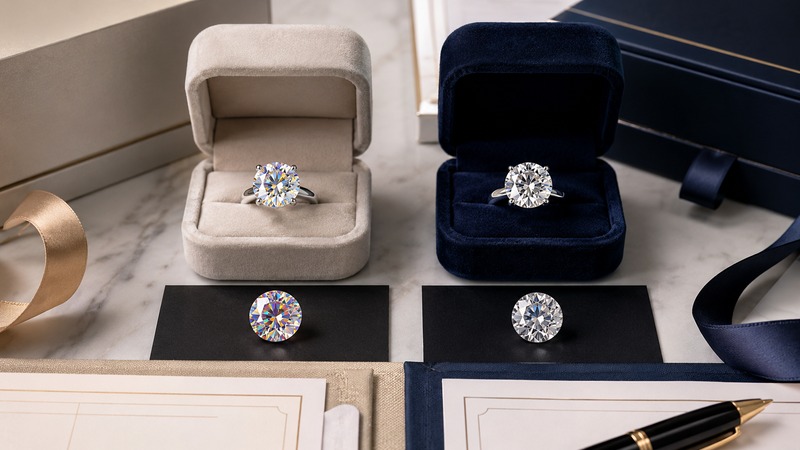
The most important difference is identity: moissanite is a diamond alternative, while a lab-grown diamond is a diamond produced in a laboratory. This affects product descriptions, advertising, packaging, invoices, and the expectations created for the customer.
The FTC Jewelry Guides provide guidance for accurate jewelry marketing and disclosure. A supplier quotation should clearly identify whether the center stone and side stones are moissanite, CVD lab-grown diamond, HPHT lab-grown diamond, or another material.
Avoid unclear descriptions such as “premium diamond quality” or “diamond-like white stone.” Precise terminology protects the buyer, supplier, retailer, and final customer from misunderstandings after delivery.
Fire, Brilliance, and Visual Appearance
Moissanite normally displays stronger rainbow fire, while lab-grown diamond produces the more familiar balance of white brilliance and dark-light contrast associated with diamonds. The better look depends on the customer’s personal preference rather than one stone being universally more beautiful.
The difference may become more noticeable in larger center stones, strong retail lighting, and elongated shapes. Oval, radiant, cushion, and emerald cuts can also show differences in faceting, depth, bow-tie appearance, and light return.
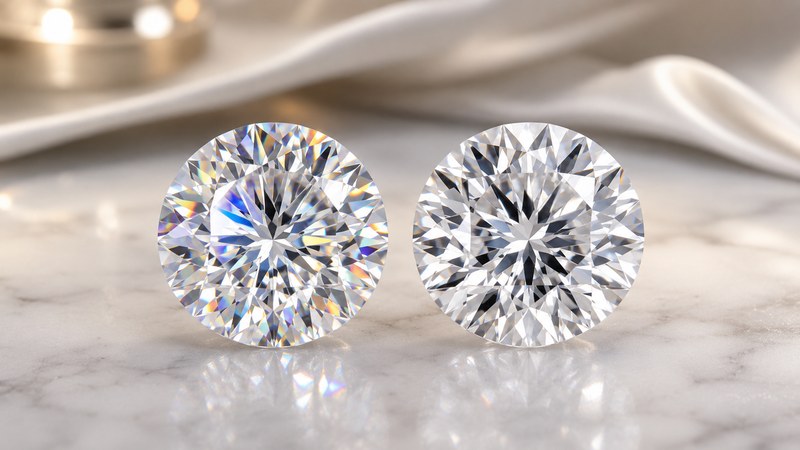
Cut quality remains important for both materials. A poorly cut stone may appear dark, shallow, glassy, or uneven even when its color and clarity labels sound impressive.
For sample approval, view both stones under natural daylight, indoor lighting, direct spot lighting, and phone-camera lighting. This creates a more realistic picture of how the jewelry will look in stores, product videos, customer photos, and social-media content.
Color and Clarity Standards
Color and clarity terminology should not be accepted without understanding the grading system behind it. Moissanite may be advertised with descriptions such as colorless, D color, or VVS, but those labels do not automatically equal diamond laboratory grades.
Lab-grown diamonds can be graded using established diamond color and clarity categories. However, paying for the highest possible grade may not produce a meaningful visual improvement in every small stone or commercial jewelry design.
For bulk orders, an approved color range and consistent appearance may be more valuable than the highest advertised grade. The supplier should define how stones are inspected, matched, and separated before setting.
| Quality Area | Questions for Moissanite | Questions for Lab-Grown Diamond |
|---|---|---|
| Color | Is the stone cold white, warm white, or within a defined range? | What laboratory or internal color grade applies? |
| Clarity | Is the stone eye-clean under normal viewing? | What clarity grade and report apply? |
| Cut | Are ratio, depth, symmetry, and faceting controlled? | Does the report or supplier specification define cut? |
| Batch matching | Will center and side stones match visually? | Will grades and appearance remain consistent? |
| Inspection lighting | What lighting is used for approval? | What lighting and magnification are used? |
| Tolerance | How much variation is accepted? | What grade and size variation is accepted? |
Carat Weight and Millimeter Size
Carat is a unit of weight, not a direct measurement of visible size. Because moissanite and diamond have different physical properties, the same carat label does not guarantee the same face-up dimensions.
B2B buyers should compare length, width, depth, and shape ratio before comparing price. This is especially important when a supplier uses terms such as “one-carat equivalent” or “two-carat look.”
| Shape | Required Measurements | Additional Visual Check | Setting Risk |
|---|---|---|---|
| Round | Diameter and depth | Face-up spread and symmetry | Incorrect diameter may not fit prongs |
| Oval | Length, width, depth, and ratio | Bow-tie and outline | Uneven ends can affect alignment |
| Emerald | Length, width, depth, and corner size | Windowing and step pattern | Corners require accurate protection |
| Cushion | Length, width, depth, and ratio | Rounded or square outline | Outline variation changes halo spacing |
| Pear | Length, width, depth, and ratio | Symmetry and tip shape | Tip needs secure protection |
| Radiant | Length, width, depth, and ratio | Corner consistency and brightness | Corner variation affects prongs |
| Marquise | Length, width, depth, and ratio | Bow-tie and point symmetry | Both points require protection |
| Princess | Length, width, and depth | Corner symmetry | Sharp corners are vulnerable |
A complete purchase order should include acceptable millimeter tolerances. Small variations can affect prong placement, halo spacing, side-stone alignment, replacement compatibility, and finished-jewelry consistency.
Durability and Everyday Wear
Both moissanite and lab-grown diamond can be used in jewelry designed for frequent wear. Lab-grown diamond offers greater scratch resistance, while moissanite is also highly resistant to normal daily scratching.
Stone hardness does not determine the complete lifespan of a ring. Metal thickness, prong construction, setting height, soldering, side-stone security, and daily impact exposure may create more practical after-sales risks.
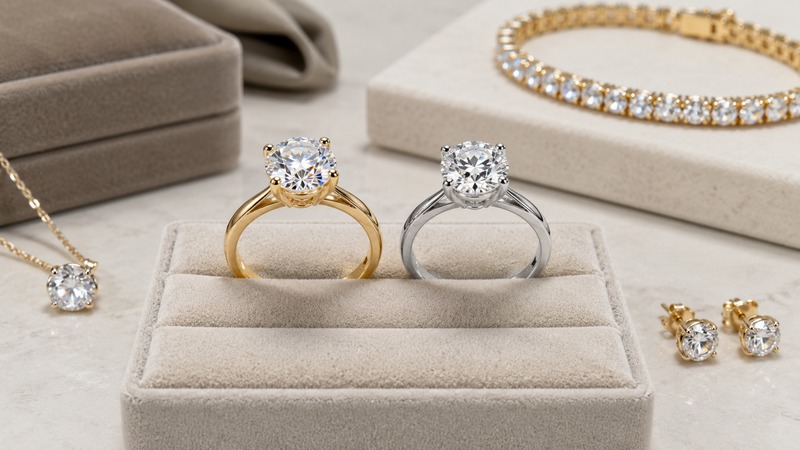
Wholesale buyers should approve a finished sample rather than judging loose stones alone. The final ring, pendant, bracelet, or pair of earrings must combine an attractive stone with secure construction and comfortable wear.
Reports, Certificates, and Documentation
Not every document called a certificate contains the same information or level of verification. Buyers should distinguish between a diamond grading report, gemstone identification report, supplier authenticity card, and product warranty.
The IGI report service demonstrates how a laboratory report can include identifying and grading information. Before ordering, confirm whether the report covers the center stone, every stone, selected pieces, or only a batch sample.
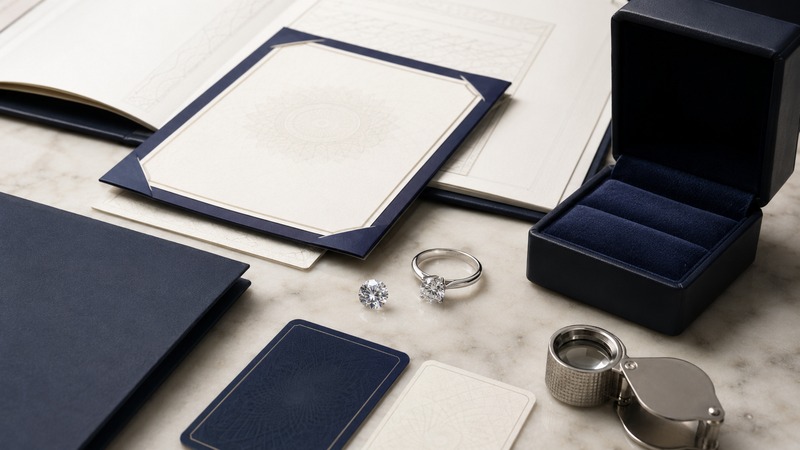
The required document type should be confirmed before quotation because it can affect cost and lead time. Buyers should also verify that any report number matches the delivered stone rather than a sample image.
Loose-Stone Price vs Finished-Jewelry Cost
Moissanite normally has a lower entry price than a comparable lab-grown diamond, but the stone is only one part of the finished cost. A reliable comparison must use the same design, stone dimensions, metal, setting, logo, packaging, and quantity.
The practical calculation is finished cost equals stone, metal, setting, production, quality control, documentation, and packaging. A lower unit quote is not better value when weak settings or inconsistent specifications create returns and replacements.
Which Stone Fits Different Jewelry Businesses?
Brands do not need to choose one stone for every customer. The same CAD design can be produced as an accessible moissanite version and a premium lab-grown diamond version.
This two-level strategy allows brands to test whether customers respond more strongly to diamond identity, visible size, price, metal, or design. It also reduces the risk of building an entire collection around assumptions that have not been tested.
Common Buying Mistakes
Comparing carat labels without checking millimeter dimensions is one of the most common mistakes. It can lead to inaccurate visual comparisons and mountings that do not fit the delivered stones.
Treating all certificates and grade labels as equal is another major risk. Buyers should confirm the issuer, grading method, document scope, and whether the report matches the delivered stone.
Comparing loose stones while ignoring finished construction creates an incomplete cost comparison. Metal weight, prong design, polishing, plating, side-stone security, and packaging all influence customer satisfaction.
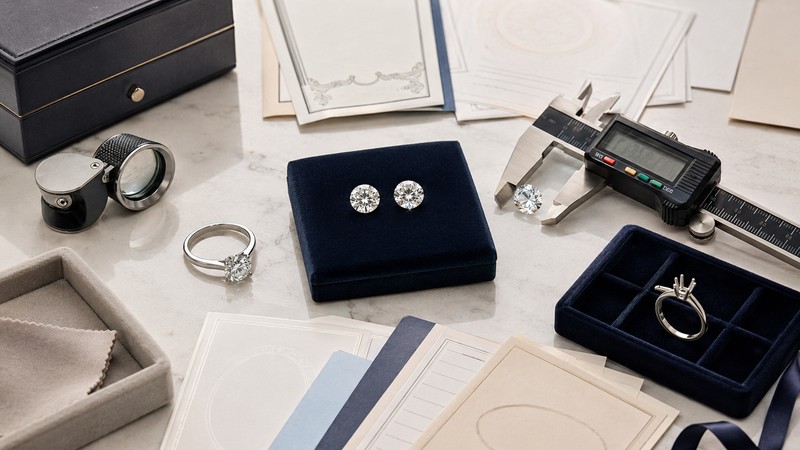
Choosing the lowest quotation without reviewing specifications can increase after-sales costs. A lower price may result from lighter metal, smaller stones, thinner plating, limited QC, or different documentation.
Unsupported environmental or resale claims should also be avoided. Reliable brands explain what they can verify rather than promising sustainability or future investment value without evidence.
How Missjeweler Supports Custom Jewelry Orders
Missjeweler supports jewelry brands, wholesalers, retailers, and online sellers developing moissanite and lab-grown diamond collections. Buyers can begin with a design reference, target price, stone size, metal, quantity, and expected delivery date.
With more than 12 years of manufacturing experience, Missjeweler focuses on clear specifications rather than vague quality promises. CAD development and finished-sample confirmation help buyers review dimensions, setting structure, metal, logo, finish, plating, and packaging before production.
Low-MOQ trial orders allow growing brands to test designs without taking unnecessary inventory risk. After sample approval, bulk production is checked for stone security, size accuracy, color consistency, surface finish, logo clarity, and safe packing.
The process is practical and transparent: confirm the specifications, approve the sample, inspect the production, and communicate any issue before shipment. This helps reduce sample-to-bulk differences and supports more stable repeat orders.
Conclusion
Moissanite delivers better value for buyers prioritizing colorful fire, visible size, and flexible pricing, while lab-grown diamond better serves customers who want diamond identity, traditional brilliance, and formal grading. For wholesale orders, the final decision should also consider dimensions, metal weight, setting security, documentation, sample approval, and bulk consistency.
Build Your Best-Selling Jewelry Collection
Send Missjeweler your design, target price, stone size, metal, and quantity for a tailored product recommendation and bulk quotation. Start with a low-MOQ sample order to confirm quality before scaling production.
FAQ
Is moissanite the same as a lab-grown diamond?
No, moissanite is a separate gemstone made from silicon carbide, while a lab-grown diamond has the carbon structure of a diamond. B2B buyers should identify the center stone and side stones correctly on quotations, invoices, product listings, packaging, and certificates.
Which stone is better for a wholesale bridal collection?
Moissanite works well for value-focused bridal collections that emphasize visible size and accessible pricing. Lab-grown diamond is more suitable for customers who specifically want diamond identity, grading information, and premium bridal positioning.
What should buyers confirm before requesting a quotation?
Buyers should provide the stone type, dimensions, tolerance, color, clarity, cut, report, metal, setting, plating, logo, packaging, MOQ, and delivery date. A complete RFQ allows suppliers to quote comparable products instead of making different assumptions.
Does every moissanite or lab-grown diamond need a report?
Not every product requires an individual report, and the decision depends on stone value, market expectations, and retail positioning. Buyers should confirm whether they need individual grading reports, identification documents, batch records, supplier cards, or no additional report.
How does Missjeweler control sample-to-bulk consistency?
Missjeweler confirms CAD details, stone specifications, dimensions, metal, finish, logo, and packaging through a finished sample before production. Bulk inspection then checks stone security, color matching, size accuracy, surface quality, logo clarity, documentation, quantity, and packing.