
Introduction
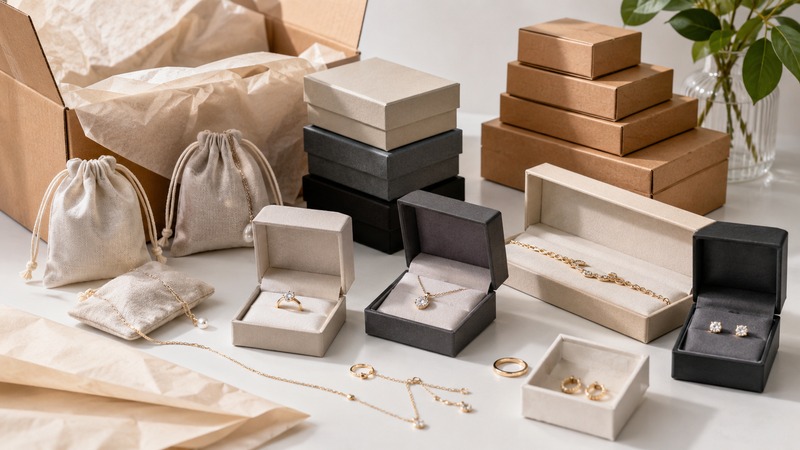
The best jewelry packaging for a small business should protect the product, support the brand, fit the budget, and remain practical at a manageable MOQ. Small jewelry brands do not need to develop many custom box sizes, colors, inserts, and finishes before customer demand is proven. Standard structures, commonly stocked colors, and simple logo methods usually provide a more controlled starting point for wholesale buying. Reducing waste also means avoiding unsuitable inserts, oversized cartons, excessive packaging SKUs, unnecessary setup fees, and packaging inventory that may become obsolete. This guide explains how to select packaging by jewelry type, evaluate suppliers, approve samples, control total costs, and build a packaging system that can scale with the business.
What Jewelry Packaging Works Best for Small Businesses?
Quick Answer: Most small jewelry businesses benefit from a tiered packaging system rather than using one expensive package for every product. Cards and pouches can support lightweight or entry-level jewelry, standard logo boxes can cover core collections, and rigid gift boxes can be reserved for premium or gift-ready pieces. Protective mailers are still required for e-commerce delivery, while care cards can provide material, storage, cleaning, warranty, and brand information. Every packaging option should be tested with the actual jewelry because external box dimensions alone cannot confirm that the insert will hold the product securely.
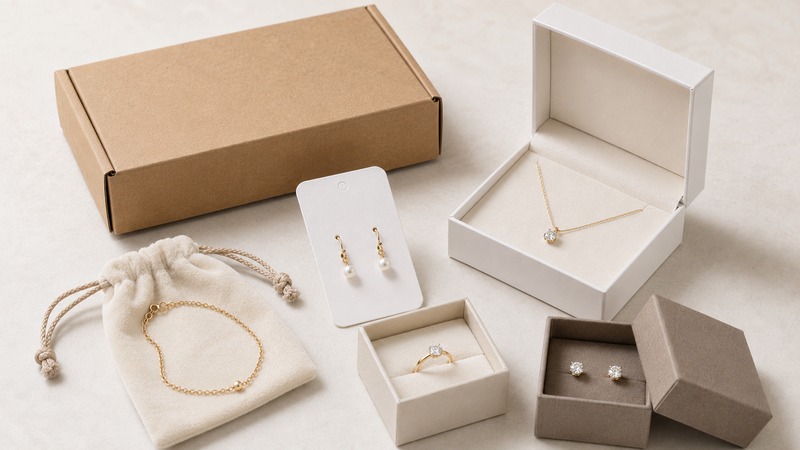
The most practical system depends on product value, dimensions, weight, sales channel, shipping conditions, storage capacity, and expected reorder volume. A small business should first control protection and consistency, then add more custom details when sales data justifies the additional inventory and setup costs.
Why Jewelry Packaging Matters Beyond Unboxing
Jewelry packaging is not only a presentation tool. A suitable package should reduce movement, prevent scratching, limit tangling, support clasps, protect stones, and maintain a consistent appearance from production to final delivery.
Poor packaging can create avoidable after-sales problems. A loose ring may move inside the box, earring posts may bend, chains may tangle, and plated surfaces may rub against hard inserts or other jewelry components. The packaging structure therefore influences product protection, customer satisfaction, return risk, and perceived value.
The correct packaging choice also depends on the product margin and selling environment. A microfiber pouch may be suitable for an affordable pendant sold online, while a rigid box with a fitted insert may be more appropriate for an engagement ring or premium tennis bracelet. The most expensive packaging is not always the most suitable packaging.
Choose Packaging by Product, Value, and Sales Channel
Confirm the Jewelry Dimensions
Before requesting a quotation, record the product length, width, height, setting profile, chain thickness, clasp size, hoop diameter, and any projecting components. These measurements help determine the correct internal space and insert structure.
For rings, buyers should confirm the setting height, band width, center-stone position, and whether the box must hold a matching wedding band. For necklaces and bracelets, confirm the total length, pendant dimensions, clasp size, chain weight, and preferred display position. Detailed product measurements reduce the risk of approving a box that looks suitable but does not hold the jewelry correctly.
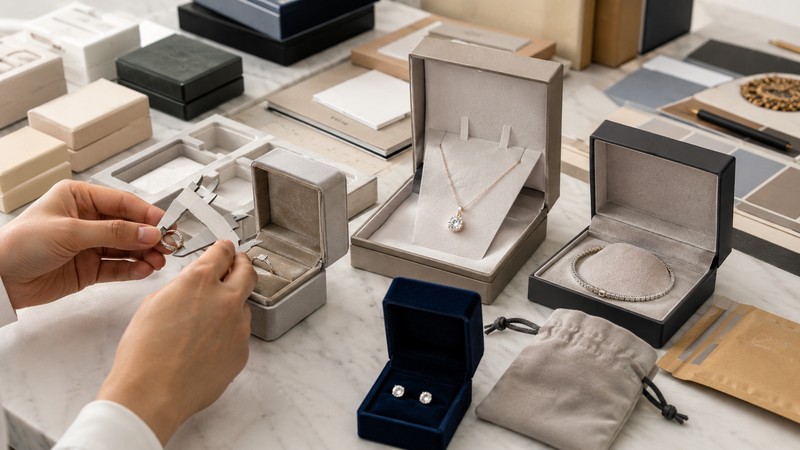
A box can have adequate external dimensions while still having an unsuitable insert. The ring slot may be too tight, the pendant hooks may be badly positioned, the chain compartment may be too shallow, or the insert may press against a hidden halo. The internal structure is usually more important than the outer dimensions alone.
Match the Insert to the Jewelry
| Jewelry Type | Recommended Insert | Main Packaging Function |
|---|---|---|
| Ring | Ring slot or removable cushion | Holds the band without pressing the setting |
| Stud earrings | Earring card or drilled insert | Keeps the pair aligned and protects the posts |
| Hoop earrings | Foam, elastic, or shaped insert | Reduces movement and bending |
| Pendant | Hooks with pendant slot | Centers the pendant and separates the chain |
| Necklace | Multiple hooks and chain compartment | Secures the chain, clasp, and pendant |
| Bracelet | Flat or gently curved insert | Maintains shape and protects the clasp |
| Bangle | Raised cushion or fitted holder | Prevents sliding inside the box |
| Heavy chain | Reinforced long insert | Supports weight and limits surface rubbing |
The insert should control product movement without creating excessive pressure. Stones, prongs, clasps, posts, and plated surfaces should not remain compressed against the insert during storage or transport.
Soft fabric does not automatically mean safe packaging. Velvet, microfiber, foam, paperboard, and elastic can perform differently depending on product weight, humidity, friction, and construction. The real jewelry sample should always be used during packaging approval.
Match Packaging to Product Value
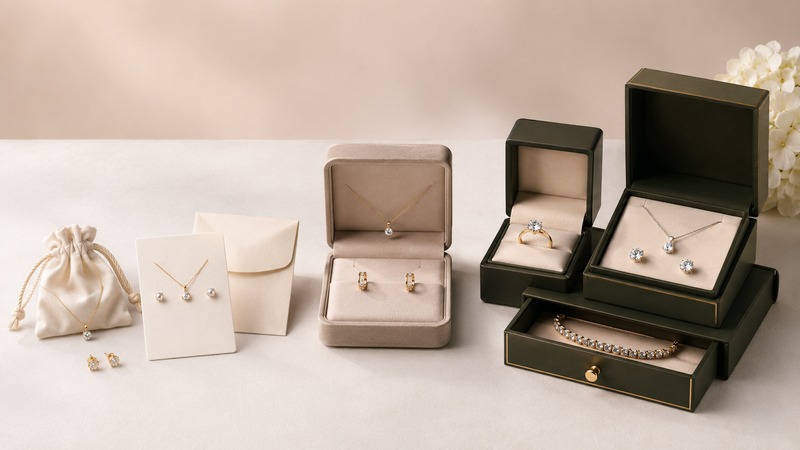
Entry-level products can often use printed cards, paper sleeves, or reusable pouches, especially when the product is lightweight and the main sale takes place online. Core collections usually benefit from a standard branded box that provides more consistent protection and presentation.
Premium jewelry, engagement rings, gift sets, and high-value products may justify rigid boxes, drawer boxes, magnetic structures, or more detailed inserts. Packaging value should remain proportionate to the product margin and the experience the brand can consistently provide.
Consider the Sales Channel
For direct-to-consumer e-commerce orders, packaging should be lightweight, protective, easy to pack, and suitable for an outer shipping mailer. Boutique retail may require display-ready boxes, while wholesale buyers may prioritize replenishment consistency and storage efficiency.
Trade shows require packaging that is portable and easy to organize, while gift-focused collections may need a more complete presentation. One packaging format does not need to serve every sales channel.
Compare Boxes, Pouches, Cards, and Mailers
| Packaging Type | Relative Cost | Protection Level | Storage Requirement | Best Use |
|---|---|---|---|---|
| Rigid jewelry box | Medium-High | High | High | Premium and gift-ready jewelry |
| Folding paper box | Low-Medium | Medium | Low | Core collections and repeat orders |
| Jewelry pouch | Low | Low-Medium | Very low | Low-MOQ and lightweight products |
| Jewelry card | Low | Low | Very low | Earrings, pendants, and small items |
| Drawer box | Medium-High | High | Medium-High | Premium collections and gift sets |
| Shipping mailer | Low-Medium | Outer protection | Medium | E-commerce delivery |
Rigid boxes provide stronger structure but increase carton volume and storage requirements. Folding boxes can reduce storage pressure, while pouches and cards usually support more flexible first orders. Buyers should compare protection, unit cost, carton size, freight, and reorder practicality together.
A shipping mailer should not replace the jewelry package itself. It provides outer protection against delivery pressure, dirt, and moisture, while the internal box, card, or pouch controls product movement and presentation. E-commerce packaging normally requires both product-level and shipment-level protection.
Choose Packaging for Each Jewelry Category
Ring Boxes
Custom ring boxes should hold the band securely without pressing the center stone, side stones, prongs, hidden halo, or gallery structure. Buyers should inspect ring-slot tension, cushion height, internal clearance, lining cleanliness, edge finishing, and opening resistance.
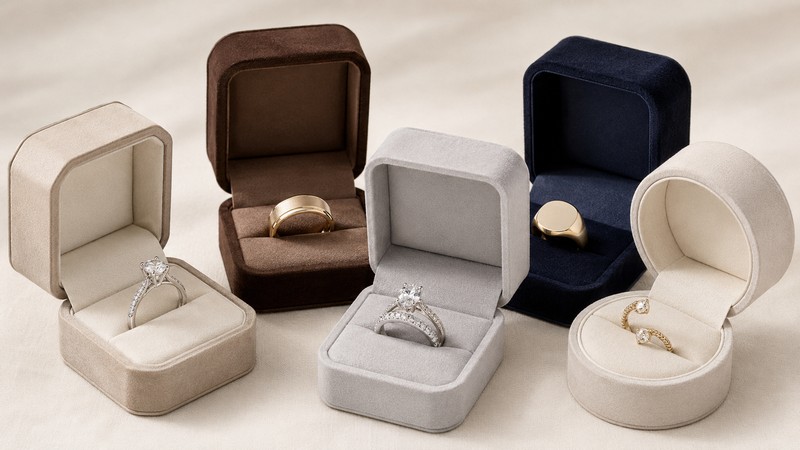
One ring slot may not suit every collection. High-set engagement rings, wide bands, bridal sets, signet rings, and adjustable rings may require different internal space. Always test representative ring styles rather than approving the box with only one basic sample.
Pendant and Necklace Boxes
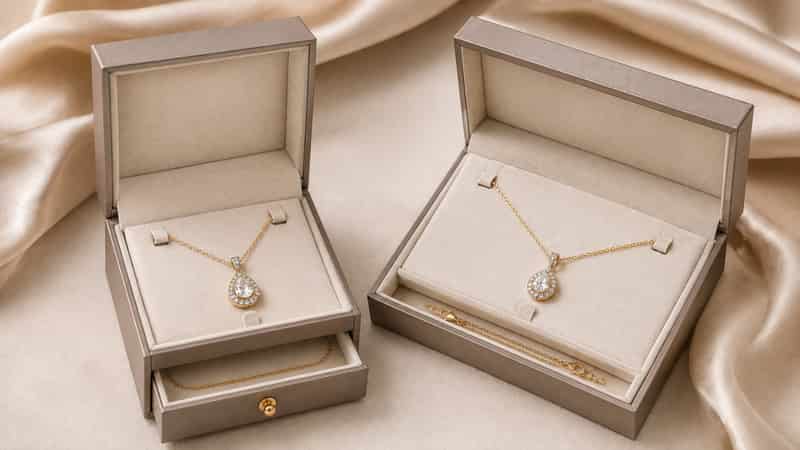
Pendant jewelry boxes should keep the pendant centered while providing enough room for the chain and clasp. Hooks, elastic bands, pendant slots, and chain compartments should work together to reduce tangling and surface rubbing.
The pendant should not move freely during transport, but the hooks should not pull the chain too tightly. Buyers should also check whether excess chain can be stored neatly beneath the insert without creating visible lumps or pressure.
Bracelet and Bangle Boxes
Wholesale bracelet boxes need stable support without squeezing clasps, stones, or hinged components. Tennis bracelets often suit flat or gently curved inserts, while bangles require sufficient internal width and a stable cushion.
An oversized box increases material and freight costs, while an undersized structure can pressure the bracelet or damage the clasp. The best box limits empty space without forcing the product into position.
Earring Boxes and Cards
Custom earring boxes can follow a tiered system. Printed cards may suit everyday studs, cards with pouches may support mid-range collections, and fitted boxes can protect premium earrings or gift sets.
Buyers should check hole spacing, card thickness, post protection, hoop diameter, product weight, transport pressure, and space for care information. Heavy earrings may tear thin cards or pull forward during display.
Chain and Statement Necklace Boxes
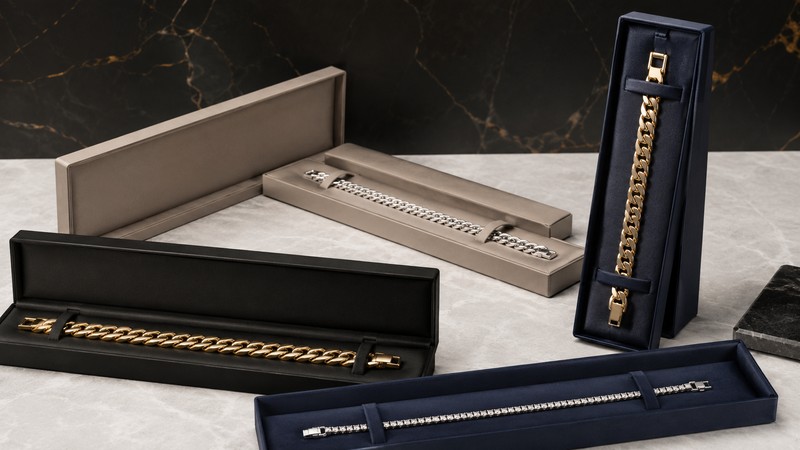
Chain jewelry boxes for Cuban chains, tennis chains, and men’s jewelry need longer and stronger inserts. Standard lightweight foam may compress under a heavy chain and allow the clasp or links to rub against plated surfaces.
A reinforced insert should support the chain weight, control the clasp position, and reduce movement without creating sharp contact points. Buyers should test the box both flat and upright because the product may shift differently during storage, display, and shipping.
Jewelry Pouches
Wholesale jewelry pouches can be made from microfiber, velvet, cotton, linen blends, satin, or similar fabrics. Pouches require little storage, can cover several jewelry categories, and often support smaller initial orders than fully customized boxes.
However, pouches provide limited crush protection and may not prevent chains from tangling. They work best when combined with a suitable inner card, tissue wrap, or protective outer mailer.
Compare Packaging Materials and Logo Methods
Rigid paperboard offers stable structure and a stronger gift presentation, but it occupies more shipping and warehouse space. Folding paperboard is easier to store and may suit repeat collections, although it may provide less premium presentation. Material selection should consider strength, weight, surface finish, storage, freight, and the customer’s expected use.
Velvet creates a rich display effect but may collect dust or show pressure marks. Microfiber is soft and lightweight but offers limited crush resistance. Cotton-linen fabrics create a natural matte appearance, although the texture may affect fine logo detail. Material photos cannot confirm softness, odor, color stability, or resistance to rubbing.
PU can provide a clean retail appearance, but buyers should check odor, surface consistency, edge finishing, and storage performance. Recycled paper can reduce the use of virgin material, but color and texture may vary between batches. A physical material sample is more reliable than a digital color reference.
| Packaging Type | Relative Cost | Protection Level | Storage Requirement | Best Use |
|---|---|---|---|---|
| Rigid jewelry box | Medium-High | High | High | Premium and gift-ready jewelry |
| Folding paper box | Low-Medium | Medium | Low | Core collections and repeat orders |
| Jewelry pouch | Low | Low-Medium | Very low | Low-MOQ and lightweight products |
| Jewelry card | Low | Low | Very low | Earrings, pendants, and small items |
| Drawer box | Medium-High | High | Medium-High | Premium collections and gift sets |
| Shipping mailer | Low-Medium | Outer protection | Medium | E-commerce delivery |
Early-stage brands usually gain more from one clear logo position and one repeatable decoration method than from using several finishes. Commonly stocked box colors and standard foil options may also be easier to sample, reorder, and match, depending on supplier availability.
Customize Packaging Without Raising the MOQ
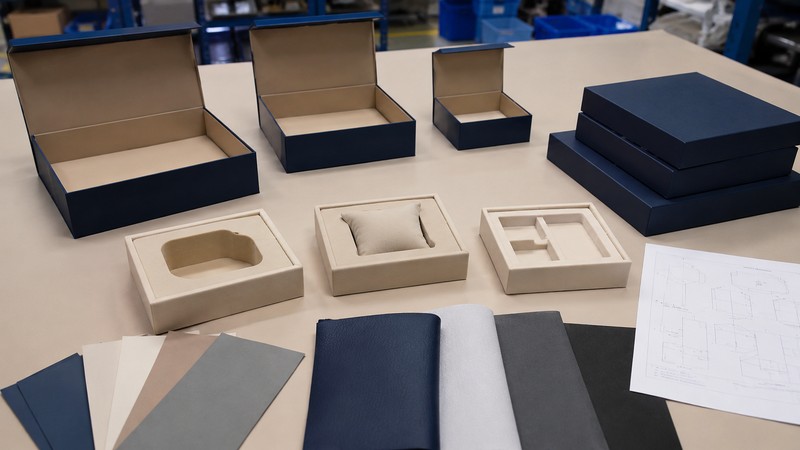
Start with the supplier’s existing box structures, dimensions, insert styles, colors, and surface materials before developing a completely new mold. Standard options usually require fewer setup steps and may support a more manageable first order.
A controlled packaging family may use two or three box sizes, one main color, one secondary color, one logo method, and a limited number of insert structures. Reducing unnecessary variations lowers inventory pressure and makes repeat ordering easier.
Ask the supplier to define MOQ by specification. Buyers should confirm the blank packaging MOQ, logo packaging MOQ, MOQ per size, MOQ per color, MOQ per insert, mixed-SKU rules, and reorder MOQ. A quoted low MOQ may apply only to one size, one color, and one decoration method.
Custom inserts, unusual dimensions, special fabrics, new molds, multiple foil colors, and individual printing designs may each introduce separate setup fees or minimum quantities. Customization should solve a functional or commercial problem rather than add complexity without a clear return.
Understand the Total Packaging Cost
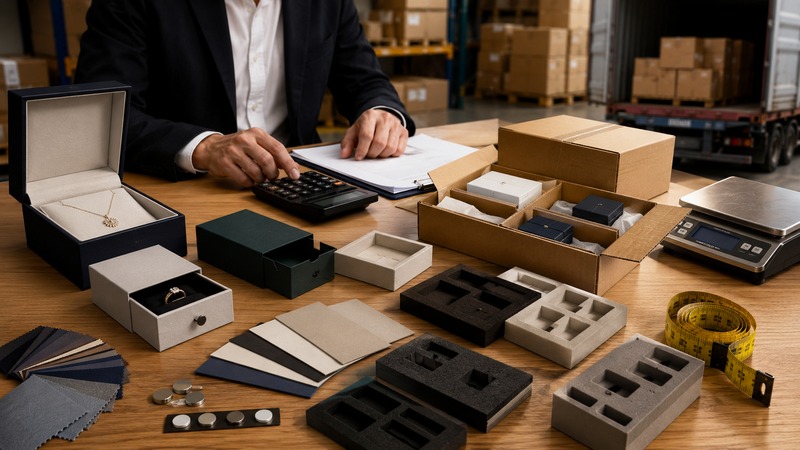
Packaging cost is determined by more than the unit price. Material thickness, box structure, insert construction, fabric, magnets, drawers, sleeves, printing, and manual assembly can all increase production complexity.
Setup charges may include foil plates, printing setup, embossing molds, insert tooling, color matching, artwork adjustment, or sample revisions. Buyers should separate reusable setup fees from unit costs and ask whether the same tooling can be used for future orders.
A practical calculation is:
Total landed packaging cost = unit cost + logo setup + sampling + inner packing + export cartons + freight + duties + storage + expected damage or replacement cost.
Higher quantities may reduce the unit price, but they also increase cash commitment, storage requirements, and the risk of outdated packaging. The lowest unit price is not automatically the lowest-risk order decision.
Carton dimensions and dimensional weight can significantly affect freight. A slightly oversized rigid box may cost more to ship and store than expected, even when its unit price appears competitive. Compare complete packing details before approving the order quantity.
Approve Samples Before Bulk Production
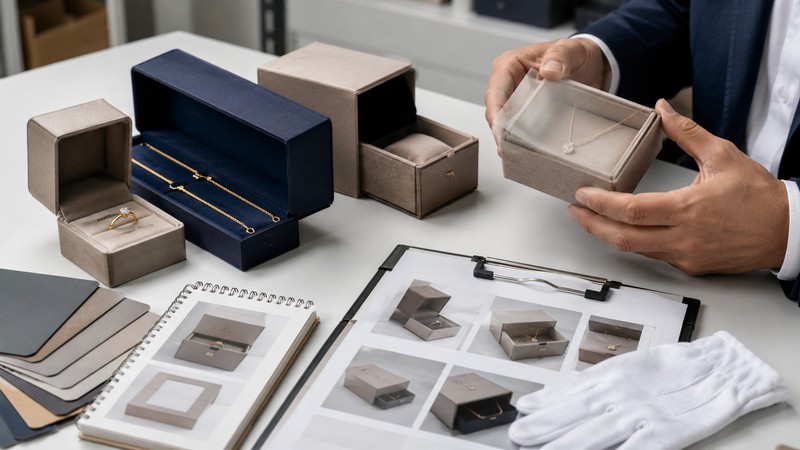
A physical sample should be approved with the actual jewelry inside. The sample review should cover product fit, insert pressure, movement, clasp position, logo clarity, color, material feel, opening method, surface cleanliness, and external condition.
Buyers should test several representative products when one package will cover multiple SKUs. For example, a ring box may need to hold both a low-profile band and a high-setting engagement ring, while a chain box may need to support several lengths and weights.
Transport performance should also be considered. Check whether corners deform, drawers slide open, magnets remain aligned, surfaces develop pressure marks, inserts loosen, or products move after the package is shaken and handled. A visually attractive sample may still fail during storage or delivery.
The approved sample should become the bulk production reference. Keep written specifications, artwork, color references, product photos, insert details, and approval comments together. Clear approval records reduce disagreements when bulk goods are inspected.
Evaluate a Wholesale Packaging Supplier
Ask the supplier for written specifications covering materials, dimensions, board thickness, insert structure, fabric, logo method, color reference, surface treatment, tolerances, packing quantity, and carton size. Product photos should support these specifications rather than replace them.
Confirm how the supplier controls sample-to-bulk consistency. The approved logo, color, insert, opening method, surface feel, dimensions, and edge quality should remain the reference for bulk inspection.
The process approach described by ISO 9001 quality management can help businesses define responsibilities, specifications, checkpoints, and corrective actions. Referencing a quality-management approach does not mean a supplier is certified unless valid certification can be verified.
Ask about repeat-order continuity as well as the first order. Confirm whether standard colors will remain available, whether the logo plate will be retained, whether setup fees will apply again, and how batch color differences are handled. Reliable replenishment is especially important for growing brands that want consistent packaging across several seasons.
Bulk inspection should check logo clarity, foil adhesion, printing alignment, color, dimensions, deformation, corners, inserts, drawer movement, magnets, stitching, stains, odor, carton quantity, and safe packing. The most useful quotation is the one that clearly defines what will be produced and inspected.
Build a Complete Packaging RFQ
A complete RFQ should include the jewelry type, exact product dimensions, preferred packaging structure, material, color, logo file, logo size and position, insert requirements, quantity, SKU count, destination country, delivery date, sample needs, and target budget.
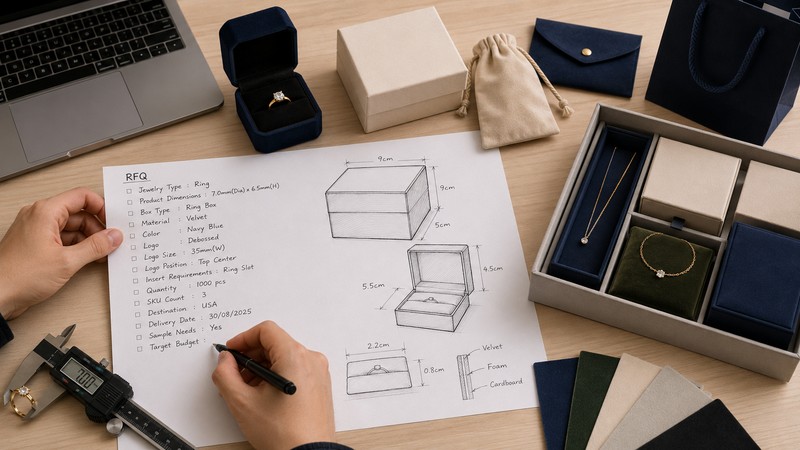
Use the following template:
We need packaging for [jewelry type]. The product measures [length, width, height, or other relevant dimensions]. We prefer [box, pouch, or card type], made from [material] in [color], with our logo applied by [method]. Please quote the MOQ, setup fees, sample cost, sample time, unit price, production lead time, packing details, carton dimensions, and shipping options to [country].
Providing complete information allows the supplier to recommend a more accurate structure and insert. An incomplete RFQ often produces quotations that cannot be compared fairly because the suppliers may be pricing different specifications.
Avoid Common Packaging and Sustainability Mistakes
Ordering before testing fit is one of the most common mistakes. A suitable outer size does not guarantee a suitable insert, especially for high ring settings, large hoops, heavy chains, unusual clasps, and statement jewelry.
Choosing packaging only by appearance can also increase risk. A beautiful box that crushes easily, allows tangling, occupies too much warehouse space, or requires an impractical replenishment MOQ is not suitable for daily business use.
Too many sizes, colors, inserts, and logo versions create additional setup fees and slow-moving stock. Small businesses should establish a controlled packaging family before expanding into seasonal or collection-specific designs.
Environmental claims also require careful review. The FTC Green Guides explain how businesses should avoid broad or misleading environmental marketing claims, while the Forest Stewardship Council provides information about responsible forest-based sourcing.
The United States Environmental Protection Agency also encourages considering materials across their life cycle. Reducing packaging layers, selecting right-sized structures, improving reuse, and avoiding oversized cartons may be more meaningful than relying only on a natural-looking surface.
Avoid unsupported statements such as “100% sustainable,” “fully recyclable everywhere,” or “zero environmental impact.” Recycling systems vary by location, and claims should match the actual paper, coatings, adhesives, fabrics, printing, documentation, and local collection conditions.
How Missjeweler Supports Small Jewelry Brands
As a B2B jewelry manufacturer, Missjeweler can coordinate jewelry dimensions, stone settings, clasps, surface finishes, packaging inserts, logo methods, and order quantities together. This allows buyers to evaluate packaging fit as part of the product-development process rather than treating the box as a separate decorative item.
Missjeweler can support custom jewelry packaging, including ring boxes, pendant boxes, bracelet boxes, earring boxes, chain boxes, pouches, logo customization, sampling, insert selection, bulk production, and final inspection. The goal is to help growing brands build a practical packaging family without committing to excessive sizes or inventory before demand is proven.
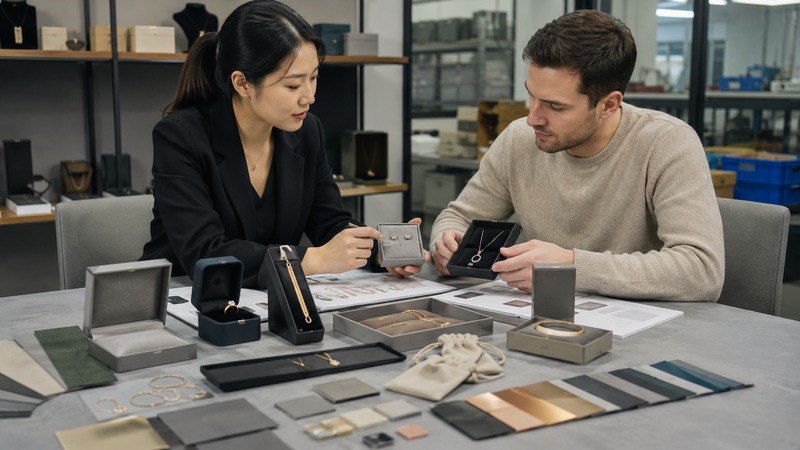
For rings, the team can review setting height and ring-slot pressure. For earrings, packaging can be checked for post protection and card strength. For bracelets and chains, the insert can be evaluated for weight support, clasp position, and surface rubbing. These product-specific details are important because packaging problems often begin with an unsuitable internal structure.
Missjeweler can also combine packaging planning with a low MOQ jewelry manufacturer approach. Buyers can first confirm the product, packaging structure, insert, material, color, logo, and physical sample before moving to a larger repeat order.
All MOQ ranges, lead times, materials, inspection points, and packaging claims should be clearly defined and verifiable. Real product-fit photos, approved samples, written specifications, and sample-to-bulk comparisons provide stronger purchasing confidence than broad quality promises.
Conclusion
The best jewelry packaging for a small business balances product protection, brand presentation, manageable MOQs, total landed cost, storage efficiency, and repeat-order consistency. By starting with controlled specifications, testing real products, and approving physical samples, growing brands can build a packaging system that supports both customer experience and profitable expansion.
Build a Scalable Packaging System with Missjeweler
Share your jewelry types, product dimensions, logo file, preferred packaging style, quantity, budget, and destination with Missjeweler custom jewelry packaging to receive a practical packaging recommendation, sample plan, and wholesale quotation.
Jewelry Packaging for Small Business FAQs
What packaging is best for a small jewelry business?
The best choice depends on product value, dimensions, weight, sales channel, and shipping conditions. Cards and pouches suit lightweight entry products, standard boxes support core collections, and rigid boxes suit premium or gift-ready jewelry.
How can I customize jewelry packaging with a low MOQ?
Use existing box sizes, standard colors, simple inserts, and one repeatable logo method. Avoid custom molds, unusual dimensions, and too many packaging variations until sales demand is proven.
Are jewelry boxes or pouches better for small businesses?
Boxes provide stronger structure and a complete gift presentation, while pouches require less storage and may support smaller initial orders. Many brands use both formats for different product levels.
Should I approve a sample before bulk production?
Yes. A physical sample confirms product fit, insert pressure, logo quality, color, material, opening feel, cleanliness, and transport performance before bulk production begins.
What should I send Missjeweler for a packaging quotation?
Send the jewelry type, product dimensions, preferred package, material, color, logo file, quantity, destination, budget, delivery date, and sample requirements so the structure, MOQ, cost, and production process can be quoted accurately.